


 PDF
PDFFull Text
The Community of Inquiry is a well-established framework developed for online education (Garrison et al., 2010). It is often used by teachers to plan, evaluate, or reflect on teaching. The framework consists of three overlapping “presences” that teachers bring to the educational experience (Figure 1). The cognitive presence relates to how teachers can help students learn to think about concepts and make sense of them. Teachers can consider which concepts are relevant, what might be difficult for students to understand about these concepts, and why. They can listen to student expressions to understand their levels of comprehension or where there are currently challenges in order to respond in ways that help students connect, apply new ideas, and learn. The teaching presence involves developing activities that support practicing relevant skills, structuring lessons, and facilitating discussions in the classroom or online. The social presence includes becoming visible and connecting as a person. A teacher can show interest in and care for students and create environments in which students feel welcome and that they matter.
|
|
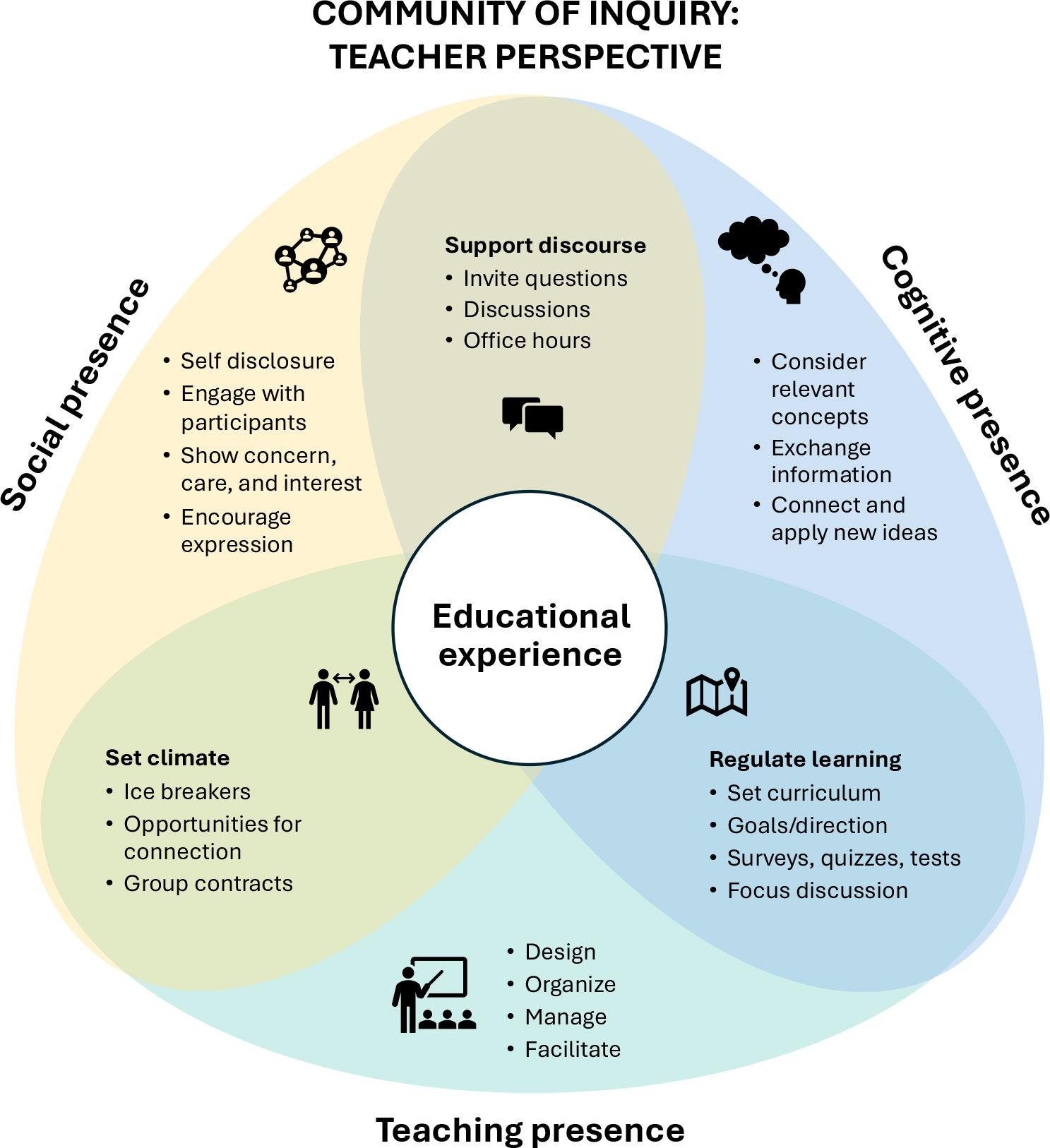
In the pairwise overlap between these main presences, we find ways the teacher can regulate learning by helping students focus on useful tasks and goals, supporting discussions both inside and outside of class, and setting the climate by encouraging students to connect with their peers and providing structure and scaffolding for collaborative work. The total of all these presences forms the educational experience in a Community of Inquiry.
The Community of Inquiry framework is also a helpful tool for diagnosing which area of the educational experience might benefit from more attention and provides ideas of what that might look like. Mendoza et al. (2026), for example, use the framework to populate the three presences and their overlap with examples of strategies for creating an inclusive and accessible hybrid classroom. Just how important it is to have all three presences combined became very clear during the COVID-19 pandemic when there was an abrupt shift to online teaching. Many teachers instinctively focused on cognitive presence, followed by teaching presence. Maintaining sufficient social presence was very difficult, especially at the beginning, as everyone had to adjust to the new situation and had to figure out what it was that was actually missing. The experience during the pandemic renewed interest in relationships in learning and teaching, and a lot of advice for building trust with, and showing care for, students exists (e.g., Anderson et al., 2020; Felten and Lambert, 2020; Gravett et al., 2021, Glessmer et al., 2024, Hamshire et al., 2025), often with the goal of working with students as partners to co-create learning and teaching (Cook-Sather et al., 2014; Bovill, 2020).
Co-creation is also where our interest lies. Even though the Community of Inquiry framework is traditionally used to shape student experiences, it considers those experiences from the teacher’s perspective. And while teachers can do a lot, we have previously argued that responsibility for learning should be a shared with students (Glessmer and Daae, 2021). What happens if we look at the Community of Inquiry framework from a student’s perspective? We share the following thoughts based on our conversation between a student (AÅ), a teacher (KD), and a colleague (MSG) to inspire other teachers not only to think about their own practice but also to consider using the Community of Inquiry framework to talk with students about how they can take responsibility for their own learning and make it more meaningful and enjoyable (see Figure 2).
|
|
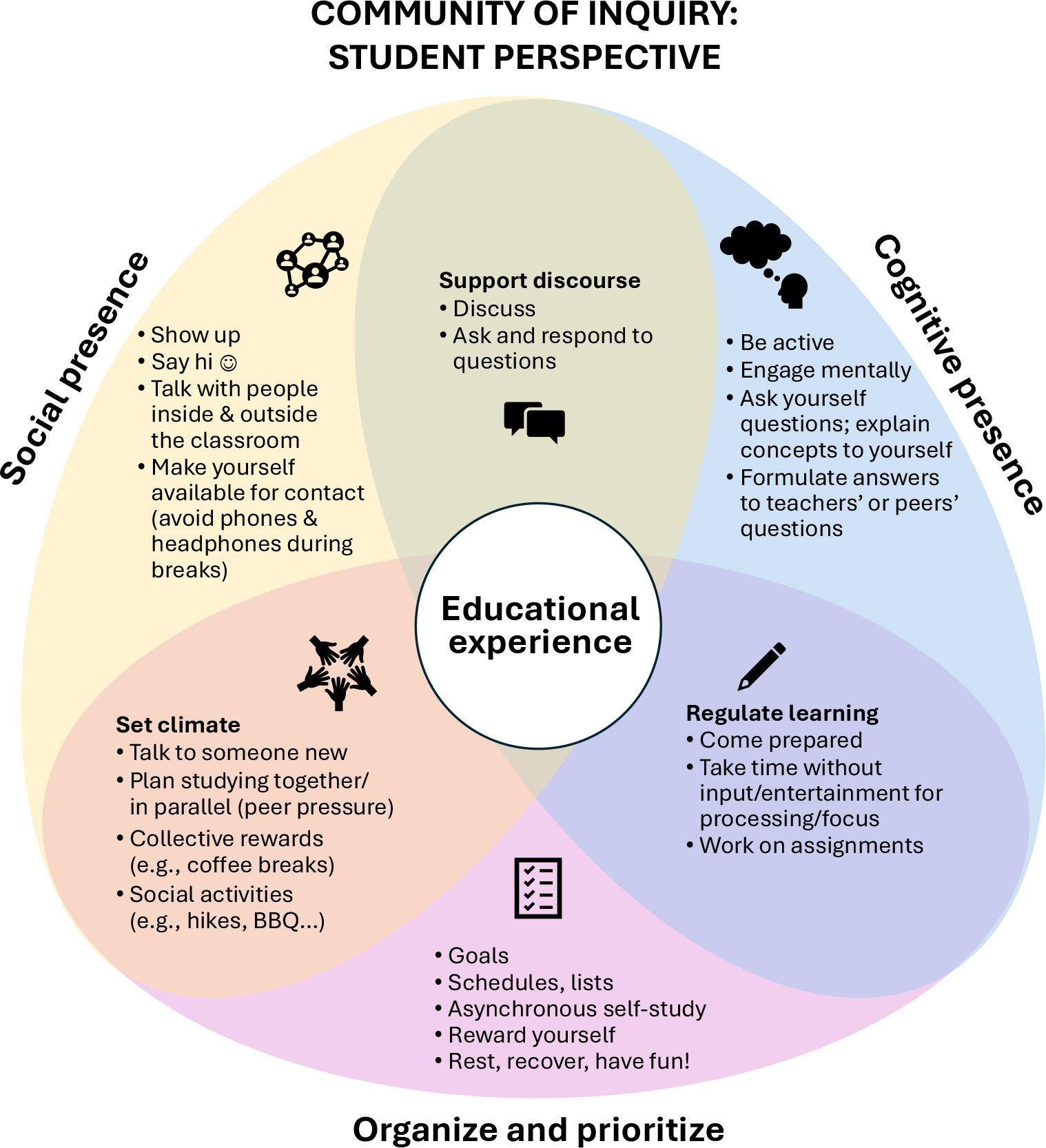
From a student’s perspective, cognitive presence involves actively engaging in learning, both during scheduled teaching sessions and outside of them. This includes asking themselves questions, trying to explain concepts to themselves, predicting what a teacher might do next in an explanation, and formulating answers to teachers’ or peers’ questions. It can also mean taking notes, even though lecture notes or slides may be provided, and writing up a summary of the learning session.
The teaching presence is, from a student’s perspective, better described as organizing and prioritizing, for example, by setting learning goals (in terms of outcomes, time spent on studying, content worked through); using schedules, lists, and asynchronous self-study time; and last but not least, rewarding oneself: rest, recover, and have fun!
From a student’s perspective, social presence means first showing up and then engaging with peers and teachers: saying “hi,” talking with people inside and outside of the classroom, and making themselves available for contact, for example, by putting away phones and headphones during breaks. However, some students may also wish to take a break from social interactions during break time, which is valid.
In the overlap between social presence and organizing and prioritizing presence, it becomes clear that, for a meaningful and rewarding educational experience, we cannot rely solely on in-class, facilitated interactions. Here, we find ways students can collaborate and integrate meaningful interactions into their lives and learning outside of class—for example, by creating accountability systems such as sticker charts for studying a certain amount of time, where the competitive element with peers might be an extra incentive to show up, or by organizing social events and activities with their peers.
It is, however, important to remember that some students, for whatever reasons, might not want to have relationships with their peers in the course but instead prefer a network separate from the course, with people they meet in other contexts or online. That is also valid, but then it becomes even more important for those students to figure out how to cultivate those relationships and use them for learning.
The other two overlaps between presences from the students’ perspective are similar to those from the perspective of teachers. Students can regulate learning by coming prepared, working on assignments, and ensuring a good learning environment, free from disruptions. They can also discuss classroom material with their peers in various settings and visit their teachers during office hours to examine difficult concepts.
So, how can teachers make use of the students’ perspectives on the Community of Inquiry framework? From our discussions, we suggest teachers consider the following steps:
- Present the framework: Explicitly point out the importance of all three presences, alone and in combination, for learning. It is not just about cognitive engagement but also about being organized and doing things with others. The teacher can also create conditions that align with the Community of Inquiry framework and highlight how the methods used are designed to help students in different ways. However, most of the strategies depend on students actively choosing to adopt them.
- Collect and share stories from older students or alumni regarding how they have organized their work alone and together, and how it has helped them. Learning always happens in a context, and examples from “close to home” tend to be accepted more easily than those that come from an article written by a team on the other side of the world.
- Talk to students about the model. Do they recognize themselves in it? What strategies do they use that could be added, and which of the ideas presented might they want to try? How can they use the model together with their peers and the teacher to co-create learning and teaching?
We found our discussions between teachers and students meaningful and relevant to help shape better educational experiences. We hope that other teachers and students can build on our ideas and co-create valuable learning experiences in a Community of Inquiry in their own contexts.