

 PDF
PDFFull Text
Innovation in teaching practices is largely based on collegial relationships and resulting feelings of individual competence and autonomy (Thirkell, 2026). Discussion among educators is one of the best ways to develop teaching competence regarding which teaching methods to use; if and how to address topics outside of the core curriculum of a subject, for example, sustainability; what resources to use for inspiration or information; which good practices to adopt or role models to consider; how to relate to students and share responsibility for learning; and how to navigate institutional or disciplinary culture. Despite their importance, such conversations often happen “backstage,” informally at the coffee machine or in an office behind closed doors, and with trusted colleagues (Roxå and Mårtensson, 2009). This makes it challenging for new instructors to find colleagues with whom they can discuss and receive support for their teaching, and many young instructors can feel isolated, especially after moving to a new institution (Wennerberg and McGrath, 2022). Contextual knowledge of local teaching practices, local regulations and how to interpret them, others’ experiences teaching disciplinary concepts, among other things, might thus be inaccessible.
Events such as teaching-focused conferences and workshops, which provide opportunities to meet other instructors, often across departmental or institutional boundaries, can be one way to address this issue. However, conversations are often restricted to the event (Dunnett et al., 2026), and many events have a “returner problem,” where ideas, intentions, and contacts may not be followed up in, or from, the “home” context (Bolander Laksov, 2024). One way to combat the returner problem might be to organize opportunities locally, for example, in a single department or faculty, and bring some of the backstage conversations out in the open. Local forums organized to discuss teaching and learning can provide easier and more frequent opportunities to continue conversations. They can contribute to local teaching culture and provide conditions for development of thematic communities (Bolander Laksov et al., 2008).
To address a lack of opportunities to discuss our own teaching, we (the authors) have successfully initiated four regular, local informal or semi-formal initiatives to discuss teaching and learning at three Scandinavian universities (see details for inspiration in Table 1). The initiatives are varied in scope, focus, and scale. While the factors contributing to their success are diverse, all were initiated bottom-up (although sometimes with support from formal leadership and/or seed funding), and we see this grassroots development as foundational to their success. The formats were determined by our own preferences and constraints as we sought to create the opportunities and discussions we wished to participate in ourselves. Some of us wanted ongoing discussions about a topic with people from across the university, so we organized regular lunch meetings to which all teachers at the university are invited (although not necessarily reached, because teachers do not have common communication channels university-wide). The absence of, and desire for, a supportive community of educators at similar career stages, or working with the same study programs, led others to build places where such a community might form. Another approach took published work as a starting point, establishing a journal club and inviting the entire department. In all examples, we intentionally chose a generous scholarship approach (Martinovic et al., 2022) that emphasizes collegiality, reciprocity, and supporting others both intellectually and emotionally over intellectual isolation or transactional relationships. We participated consistently and were invested in the communities we were developing through these regular meeting opportunities.
TABLE 1. Overview of four example initiatives, their goals, their concrete interpretation of the Wenger et al. (2002) principles, and other success factors and challenges. > High res figure |
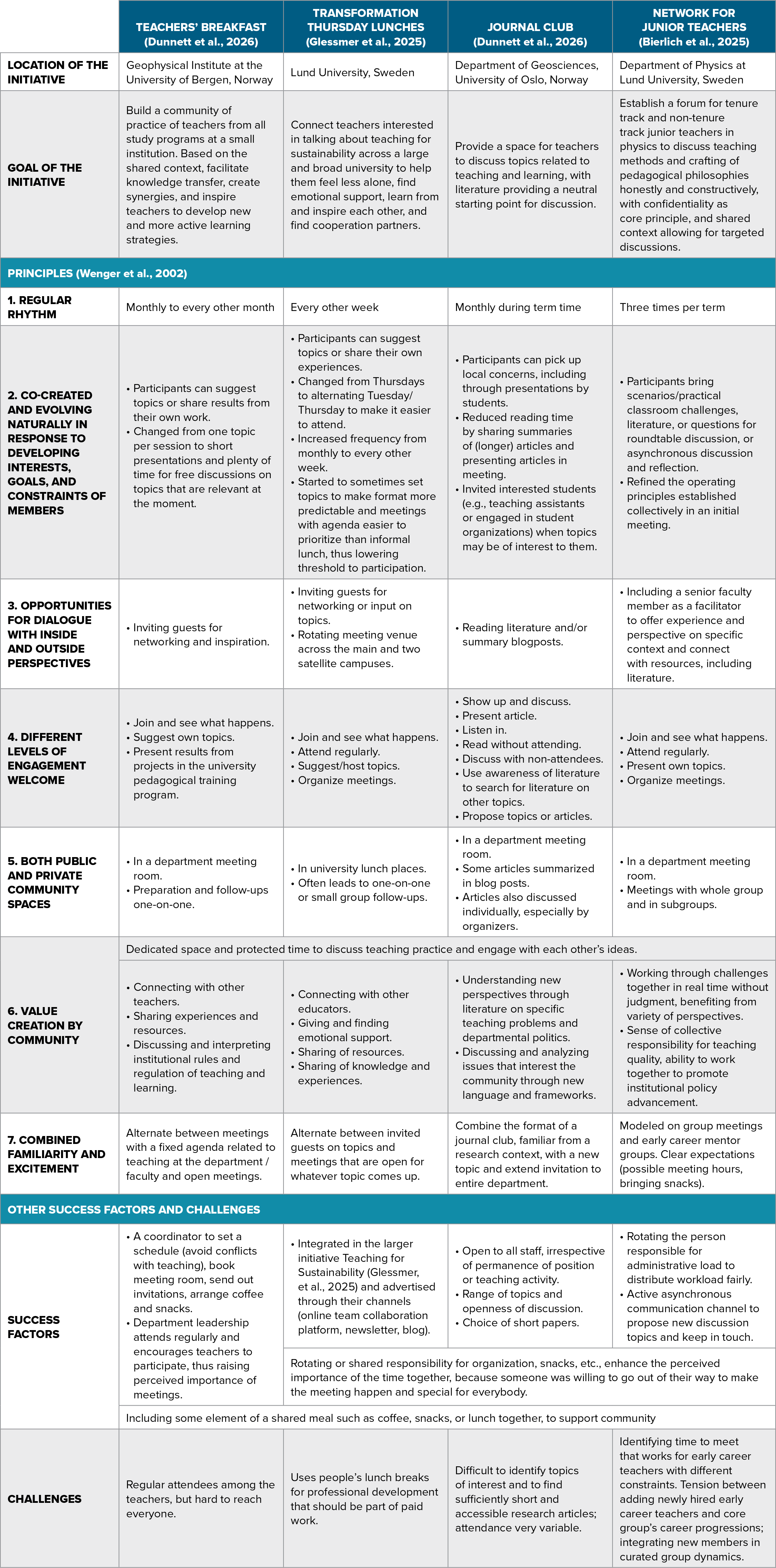
As well as immediate opportunities for conversations, all initiatives aimed to create local Communities of Practice (Wenger, 1998), where people meet regularly to learn more about a shared concern or passion. The design of the initiatives was informed by the seven principles suggested by Wenger et al. (2002).
- Despite their informal nature, all initiatives involve regularly planned and organized meetings that have a consistent basic form and are advertised through predictable channels.
- The communities are co-created and allowed to evolve naturally in reaction to the developing interests, goals, and constraints of their members.
- Meetings provide opportunities to start and continue dialogue based on both inside and outside perspectives (e.g., knowledge of community interests, issues, and challenges on the one hand, and introduction of new ideas and possibilities on the other).
- Different levels of participation are possible: everybody who attends a meeting is respected and welcome, and their contributions to the conversations are considered valid, regardless of prior attendance or level of expertise.
- The communities exist both in public spaces, with open, well-advertised meetings, and in private spaces, as conversations between meetings.
- All communities explicitly reflect on and discuss the value of the respective community for sustaining motivation and momentum, both for organizers and participants.
- While the format of the meetings is often characteristic of an academic environment, the topic and the speakers can be unusual, and extra, quasi-spontaneous events can also occur.
In Table 1, we illustrate the practical implementation of the seven principles with our four cases and note some other factors that stand out to us as helping or hindering success.
We started our communities of practice bottom-up with us as the main drivers, but the seven principles can also be used to design a community of practice “from the outside.” Based on our experience with the success of our four communities of practice and seeing many unsuccessful efforts to create similar communities top down, our recommendation to leaders who would like such a community for their teachers is to model the behavior they want. Show up: if leaders and organizers cannot be bothered, why should anyone else? Be friendly and inviting; engage with the topics to show that you care and that these discussions matter. And if you do hand over organizing responsibilities, continue attending. If you delegate organizing events, or if someone proposes establishing such a venture as a grassroots initiative, turn up occasionally (i.e., once a term) and show interest and support. Support may look like financing the snacks or installing a fancy coffee machine as a meeting point (Bolander Laksov et al., 2008); offering to “reply all” to the invite and emphasizing that this is a good opportunity for everyone in the department (and then doing so unprompted); highlighting the venture in, for example, departmental meetings; providing administrative support; or making sure that the opportunity is known to be endorsed by department leadership.
Communities of practice are not infinitely self-sustaining. They require continual committed leadership and engaged participation to stay meaningful; otherwise, they will drastically transform or even die (Wenger et al., 2002). However, community forming groups and meeting opportunities such as any of those we describe can be valuable to participants regardless of whether they last one year or 30. For all of us, these initiatives have been fulfilling work, made meaningful through the communities we sought and found.