
 PDF
PDFFull Text
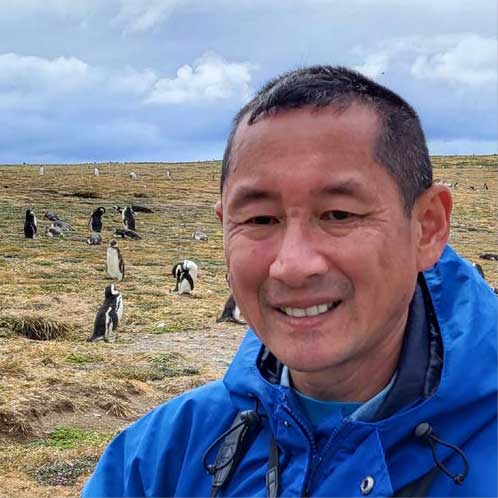 |
Shane Guan, Oceanographer, Bureau of Ocean Energy Management, and Adjunct Assistant Professor, Department of Mechanical Engineering, The Catholic University of America
Degree: When, where, what, and what in?
I received my BSc degree in fisheries science from Nagasaki University, Japan, in 1993, where I was first exposed to marine bioacoustics during a study of humpback whale song structures off Okinawa. Following that experience, I enrolled in the Grice Marine Biology Program at the College of Charleston and earned an MSc degree in marine biology in 1998. My thesis research was on acoustic behavior of free-ranging bottlenose dolphins in the Charleston estuaries. After about 10 years working with the US Fish and Wildlife Service (USFWS) and the National Oceanic and Atmospheric Administration (NOAA), I pursued a PhD degree in underwater acoustics at the Catholic University of America (CUA), where I graduated in 2016. My dissertation research focused on anthropogenic underwater sound and marine soundscape characterization.
Did you stay in academia at all, and if so, for how long?
I always thought that I would like to stay in academia studying marine bioacoustics. But when I completed my MSc degree in the late 1990s, there were very few graduate programs offering that field (my thesis major advisor was an ornithologist!). So, I accepted a job offer as a government biologist, which led to a different career path. However, after completing my PhD, I was offered an adjunct assistant professor position teaching graduate-level classes in ocean acoustics, marine bioacoustics, and computational methods, which I gladly accepted and continue to this day. Though this is a part-time position beside my full-time career with the Bureau of Ocean Energy Management (BOEM), I enjoy the campus atmosphere and scholarly discussion with university faculty and students.
How did you go about searching for a job outside of the university setting?
By the time I completed my MSc degree, the Internet was just becoming a great place to look for jobs beyond the local commuting area. The US government employment website was launched in 1996, and I was able to find many opportunities there. I focused my search on marine biology/zoology related fields and was able to land a job as a biologist at the headquarters of the USFWS Fisheries Program in the Washington, DC, metro area.
Is this the only job (post-academia) that you’ve had? If not, what else did you do?
No. After six years with the USFWS working on native freshwater fish conservation, which also included a six-month temporary assignment with the US Coral Reef Task Force, I took a job with NOAA Fisheries. My duties at NOAA were to assess anthropogenic noise effects on marine mammals for the issuance of incidental take authorization (ITA) under the Marine Mammal Protection Act. Utilizing my expertise on underwater acoustics and marine bioacoustics, I provided technical advice to the ITA program. In this capacity, I also developed many noise impact assessment tools and guidelines, and mentored colleagues who did not have acoustics backgrounds. While at NOAA Fisheries, I also took two short-term assignments at other NOAA line offices. One was with the US Integrated Ocean Observing System (IOOS), where I led the development of a metadata convention for underwater passive acoustic recording. The other was with the NOAA Office of Ocean Exploration Research, where I led the environmental assessment for the operations of NOAA Ship Okeanos Explorer. Due to my expertise in underwater noise effects on marine species, I was also invited to Taiwan many times to advise on monitoring and mitigation strategies to protect the critically endangered Taiwanese humpback dolphin from underwater noise exposure generated from offshore wind farm development.
What is your current job? What path did you take to get there?
I started my current job with BOEM in 2020 as an oceanographer in the Environmental Studies Program (ESP). My roles are to develop, fund, and manage underwater acoustics, acoustical oceanography, and marine bioacoustics studies that support BOEM’s mission to assure that offshore energy, mineral, and geological resources are developed in an environmentally responsible way, and to ensure that BOEM’s regulatory decisions are informed by the best available science and are fully compliant with statutory obligations. I work closely with external and internal scientists to conceptualize and formulate research ideas and turn them into studies that advance BOEM’s mission. In the years since I joined the bureau, I have participated in research projects, led workshops, and collaborated on papers and reports. As with my previous government positions, I simply applied for the job on https://www.usajobs.gov/ and went through the competitive hiring process.
What did your oceanographic education (or academic career) give you that is useful in your current job?
I took quite extensive oceanographic and marine science courses—ranging from physical and biological oceanography, marine geology, ichthyology, marine zoology, and botany to aquaculture and even maritime affairs—both in my undergraduate and post-graduate (master’s) years. These classes provided me with broad knowledge and appreciation of topics related to ocean science and technology that are critical in pursuing my career as an ocean acoustician.
Is there any course or other training you would have liked to have had as part of your graduate education to meet the demands of the job market?
Machine learning, geospatial tools, and software developer platforms. Though I am a proficient MATLAB user, which enables me to perform a variety acoustic signal processing tasks and analyses at work, I wish that I had had more training in information technology early on.
Is the job satisfying? What aspects of the job do you like best/least?
Absolutely! Being able to connect with academia and actively participate in research is the best part of my job. It is satisfying to know that the study results are valuable to resource managers for environmental compliance and science-informed decision-making. However, the ever-shifting change in priorities can sometimes be challenging to ensure the continuity of studies.
Do you have any recommendations for new grads looking for jobs?
Be flexible and look beyond your field of study. Oceanography is an interdisciplinary field, and I have observed that graduate students with cross-disciplinary knowledge and expertise are more likely to land jobs than those who only focus on their specific fields. Additionally, networking during conferences and workshops and being active in professional societies are great ways to establish connections that could lead you to your dream job.