
 PDF
PDFFull Text
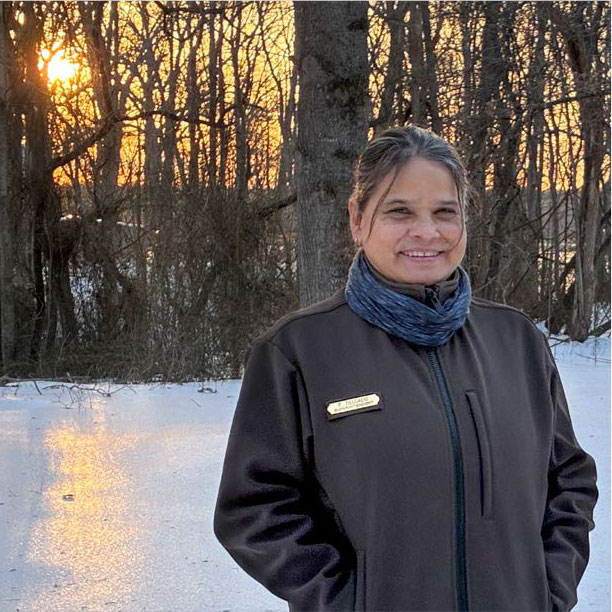 |
Patricia Delgado, Superintendent, Jug Bay Wetlands Sanctuary, Ann Arundel County (Maryland) Department of Recreation & Parks
Degree: When, where, what, and in what field?
I earned my bachelor’s degree in marine biology from the Universidad Nacional in Costa Rica in 1991. The following year, thanks to a scholarship from USAID, I was given the opportunity to pursue a master’s degree in the United States and was accepted in the Oceanography and Coastal Sciences program at Louisiana State University. After graduation in 1995, thanks to my major professor, I was able to remain in the same program and work toward a PhD, which I completed in 2001. Throughout all my studies, I focused my research on wetland ecosystems: mangroves during my undergraduate studies, bottomland hardwood forests during my master’s program, and back to mangroves for my dissertation work, which I did in Costa Rica.
Did you stay in academia at all, and if so, for how long?
I did not stay on the academic path, and to be honest, it was never one of my personal career goals. However, after graduating I did accept a short postdoctoral research position at the University of Louisiana at Lafayette.
How did you go about searching for a job outside of the university setting?
I searched for jobs probably as most people do, looking for opportunities online with different state and federal agencies and nongovernmental organizations (national and international), where I thought I could find a good fit. However, networking was what really helped. Not long after graduation, I participated in a special event for recent minority PhD graduates where I had the opportunity to meet and make connections with professionals from different fields and organizations. It was through this event that I obtained the contact information for someone working at NOAA. Thanks to this contact, I was able to share my CV with hiring officials from several NOAA offices. This eventually led to my first job outside academia as a NOAA contractor (Marine Habitat Resource Specialist), and the start of my career outside academia.
Is this the only job (post-academia) that you’ve had? If not, what else did you do?
After that first job at NOAA, I have had three more positions outside academia. The first was also at NOAA, but in a different line office, working under the National Estuarine Research Reserve System (NERRS) program, which brought me closer to my professional interests. Through this position I was able to move to my next job at the Maryland Department of Natural Resources as the Research Coordinator of the Maryland Chesapeake Bay National Estuarine Research Reserve (CBNERR-MD). This position allowed me to get back into field research, which was a professional goal for me. The third and current position at Jug Bay Wetlands Sanctuary has not only allowed me to continue doing wetland research but also provides opportunities to explore other fields of land management and public outreach and education.
What is your current job? What path did you take to get there?
My current position is Superintendent of the Jug Bay Wetlands Sanctuary, a Natural Area in Anne Arundel County’s Department of Recreation and Parks (Maryland). How I ended up in this job was very much linked to my previous position as the CBNERR-MD Research Coordinator. In that position, I led and conducted research and monitoring projects within the three components that form part of CBNERR-MD. One of these components was Jug Bay, part of which (Anne Arundel County’ side) is managed by the Jug Bay Wetlands Sanctuary superintendent. Through the work I was doing at Jug Bay I became familiar with the site, its staff, and its overall mission and goals. When the Sanctuary superintendent retired, I took the opportunity to apply for a position that had many of the key aspects I was looking for in a long-term job. These included continuing to conduct wetland research while also gaining new skills and experience in natural resource conservation and management as well as community outreach. I believe that the familiarity and knowledge I gained by working at Jug Bay as CBNERR-MD Research Coordinator helped tremendously in making me more competitive for the position in comparison to other applicants.
What did your oceanographic education (or academic career) give you that is useful in your current job?
All of the knowledge and research experience that I gained through my undergraduate and graduate studies have been key in my current position. Jug Bay Wetlands Sanctuary has a long history of supporting research in the environmental sciences and a legacy of supporting robust citizen science, monitoring, and research programs. It was therefore desirable for the county to have a superintendent with a solid science background and research experience to continue that legacy. My background in wetland ecology science was key to developing new research and monitoring projects for the sanctuary. Experience as a researcher helped me to bring in financial support through grant writing, mentor students in an exciting summer research internship program, and develop new partnerships and collaborations with outside researchers from local academic institutions. In addition, my education proved useful while implementing land management efforts (habitat enhancement and restoration) for the protection of the Sanctuary’s natural resources.
Is there any course or other training you would have liked to have had as part of your graduate education to meet the demands of the job market?
At the time I was completing my education, advanced training in GIS and SAS would have been useful, as well as some knowledge about grant writing. Now, there are many new tools and applications available for scientific data collection and analyses that could be offered as part of graduate education training to provide needed skills and make a recent graduate more “marketable” while job searching.
Is the job satisfying? What aspects of the job do you like best/least?
I can say with certainty that this is my dream job! Remaining active as a researcher while also managing a natural area is very rewarding and fulfilling. This position has allowed me to continue doing what I love while also providing the opportunity to challenge myself and gain new skills and knowledge that I never thought I would have. In addition to being a researcher, I have learned how to be a steward of the land, an educator, and an advocate for the protection and conservation of the Sanctuary’s natural resources. In addition, I am privileged to work with very special people, a hard-working and dedicated staff and a corps of volunteers who are all always willing to give their time and best efforts to protect the environment and hopefully ensure its preservation for future generations.
Do you have any recommendations for new grads looking for jobs?
Even if you do not find that perfect job from the very beginning, do not give up on your dreams—and do not be shy about using your network to help you achieve them!