
 PDF
PDFFull Text
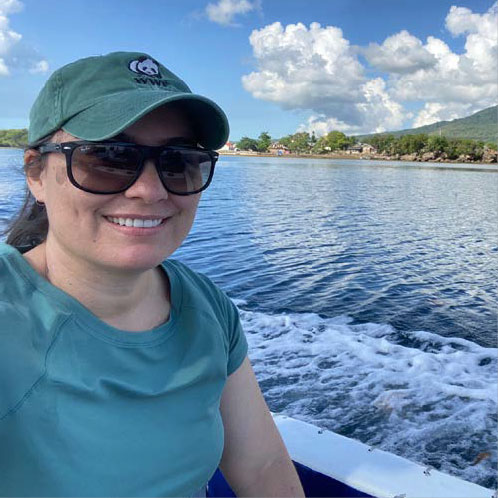 |
Gabby Ahmadia, Vice President, Seascapes and Science, World Wildlife Fund Oceans
Degree: When, where, what, and what in?
I took a bit of a long and winding path through my degrees. It began at Humboldt State University, where I took five years to earn a degree in zoology, in part because I was also playing college soccer—a big part of my identity at the time. From there, I went to the University of West Florida for my master’s degree in marine biology. That was where I was first exposed to international research, which really shaped what I wanted to do next. I then went on to Texas A&M Corpus Christi for my PhD in coastal and marine systems science, focusing on coral reef fish ecology. I was lucky to work with my advisor, Frank Pezold, who was incredibly supportive. He encouraged me to follow my own interests and career path rather than steering me toward his, which made a lasting impact.
Did you stay in academia at all, and if so, for how long?
Not at all. Toward the end of my PhD, I applied broadly to jobs both within and outside academia. I ended up landing a reef monitoring postdoc at World Wildlife Fund (WWF) right after graduating and have stayed ever since. I am now coming up on 14 years with the organization.
How did you go about searching for a job outside of the university setting?
This was a while ago, and the landscape has changed a lot since then. At the time, I relied heavily on listservs and word of mouth. I remember several people forwarding me the WWF job, thinking it would be a good fit. I also tried to be intentional about timing. I started my job search about six months before graduating and did not rush to finish my degree because I still had funding and health insurance. That extra time allowed me to focus on both the job search and wrapping up manuscripts from my PhD research.
Is this the only job (post-academia) that you’ve had? If not, what else did you do?
Yes, this has been my only role since finishing my PhD. That said, during my academic years I did a wide range of jobs. I washed athletes’ laundry, which was not glamorous, did some consulting on data analysis, helped run a research station, and organized the local Ocean Sciences Bowl. Those experiences, even the less exciting ones, all added something along the way.
What is your current job? What path did you take to get there?
I am currently the VP of Seascapes and Science at WWF Oceans. My interest in this field really started early. I grew up in Hawai‘i and took a marine biology class as a kid that involved going down to the shoreline to learn about the organisms there. That experience stuck with me. Even though I mostly saw myself as an athlete growing up, I always worked hard in school. As an undergraduate, I did not follow the typical path that many science students take. While others were doing internships, I was working for a local baseball team, spending time at the multicultural center, and picking up whatever jobs I could, including washing some very smelly laundry.
I went on to a master’s program focused on marine ecophysiology, but over time I realized I was more drawn to ecology and fisheries science. I enjoy working with data and thinking about systems at a larger scale. For my PhD, I shifted into coral reef fish ecology, which gave me the opportunity to conduct research across the Pacific and Indian Oceans. I had to be resourceful in finding funding, piecing together small grants and AmeriCorps support to make that work.
After finishing my PhD, I joined WWF in a role focused on designing a monitoring program in Indonesia. Helen Fox, who was the Director of Marine Science at WFF, played a key role in mentoring me during that time, especially in helping me understand how to be a strong and respectful partner to local scientists. Over the years, I have had the opportunity to work with an incredible range of partners and teams, helping to connect solid science with conservation in practice. While my role now leans more toward the conservation side, I still rely heavily on scientific thinking and on the scientists on my team when designing and implementing programs.
What did your oceanographic education (or academic career) give you that is useful in your current job?
My academic training gave me a strong foundation in understanding what good science looks like and how to apply it in real-world settings. It also built resilience. Research comes with a lot of ups and downs, and learning how to navigate that has been invaluable. It also instilled in me a sense of curiosity and a habit of questioning assumptions. That mindset has carried through into my career and has helped me stay open to learning and adapting as I take on new challenges.
Is there any course or other training you would have liked to have had as part of your graduate education to meet the demands of the job market?
I think having a well-rounded academic experience is really important. Taking courses that span both policy and the natural sciences can make a big difference. Increasingly, scientists want their work to inform decisions, which means understanding the political and social context in which that work sits and being able to communicate effectively with a wide range of audiences.
I was also taught at one point that scientists should not be advocates. In practice, I do not think that fully holds. If you are not advocating for your work and its relevance, it is unlikely that others will step in to do that for you.
Is the job satisfying? What aspects of the job do you like best/least?
I find the job very satisfying. Being part of a mission-driven organization and working alongside smart, motivated colleagues is incredibly rewarding. One of the best parts of the role is the opportunity to travel and see conservation work firsthand, and to meet the people who are driving that work on the ground. At the same time, travel has become more complicated now that I have a young child at home. Another challenging aspect of the role is the amount of time spent on fundraising. While it is essential to sustaining the work, it does take time away from the parts of the job that I most enjoy.
Do you have any recommendations for new grads looking for jobs?
Persistence is critical. You will hear “no” many times but continuing to put yourself out there and staying open to opportunities both make a difference. It is also important to apply for roles even if you do not meet every listed qualification.
From a hiring perspective, I look not only at experience but also at whether someone is adaptable, curious, and willing to take on new challenges. Those qualities often matter just as much as checking every box on a job description.