The ocean, covering more than two-thirds of our planet, exerts a profound influence on Earth’s climate system by regulating regional climates, driving weather patterns, and absorbing and redistributing vast amounts of heat and carbon dioxide from the atmosphere. Despite its central role, the global ocean remains largely unexplored, owing both to its immense scale and to the opacity of seawater to the electromagnetic signals commonly used in atmospheric and space-based observations. As a result, satellite coverage is largely restricted to the ocean’s surface and upper tens of meters. In this context, the Argo program, through an extraordinary international collaboration, has emerged as a transformative force over the past 25 years, deploying a global fleet of autonomous underwater profilers that have delivered sustained, frequent, and widespread measurements of the ocean’s interior dynamics and properties (Roemmich et al., 1999, 2019; Thierry et al., 2025).
As members of the Phenomena, Observations, and Synthesis (POS) Panel of the US Climate Variability and Predictability Program (US CLIVAR), we are inspired to highlight Argo as a remarkable international success story. The mission of the POS Panel is to improve understanding of climate phenomena, inform the needs for a sustained global climate observing system, and guide the development of global climate-relevant datasets and model synthesis. Our range of expertise in ocean and climate science enables us to assert that Argo affects virtually everyone who depends on or cares about weather prediction, ecosystem health, and national security, both in the United States and globally. Argo’s impact resonates across various sectors, from academic research to practical applications in industries and government, making it a fundamental piece of modern Earth system science.
Here, we spotlight a critical juncture regarding the future of monitoring Earth’s biosphere with Argo. We champion continued investment in this critical infrastructure that advances and directly supports US federal research priorities while serving as a model for sustained multinational scientific cooperation. Through partnerships between governments, academia, nonprofit research institutions, and industry, Argo supports ocean data assimilation and modeling, workforce development in data sciences, and ongoing exploration of the ocean and polar regions. Together, these efforts accelerate technological and scientific innovation and result in the delivery of applied science products to stakeholders.
Key Outcomes from 25 Years of Argo
For over two decades, Argo has been a core component of the Global Ocean Observing System (GOOS), coordinated internationally through the United Nations Educational, Scientific, and Cultural Organization (UNESCO). The Argo program has transformed oceanography from a data-sparse discipline into one grounded in sustained, global observations of the ocean’s interior (Figure 1). Numerous comprehensive reviews (e.g., Riser et al., 2016; Roemmich et al., 2019; Wong et al., 2020; G.C. Johnson et al., 2022; Thierry et al., 2025) have documented these advances in detail. Rather than reiterating individual findings, we synthesize Argo’s principal outcomes across three domains: scientific discovery, operational capability, and education (Figure 2).
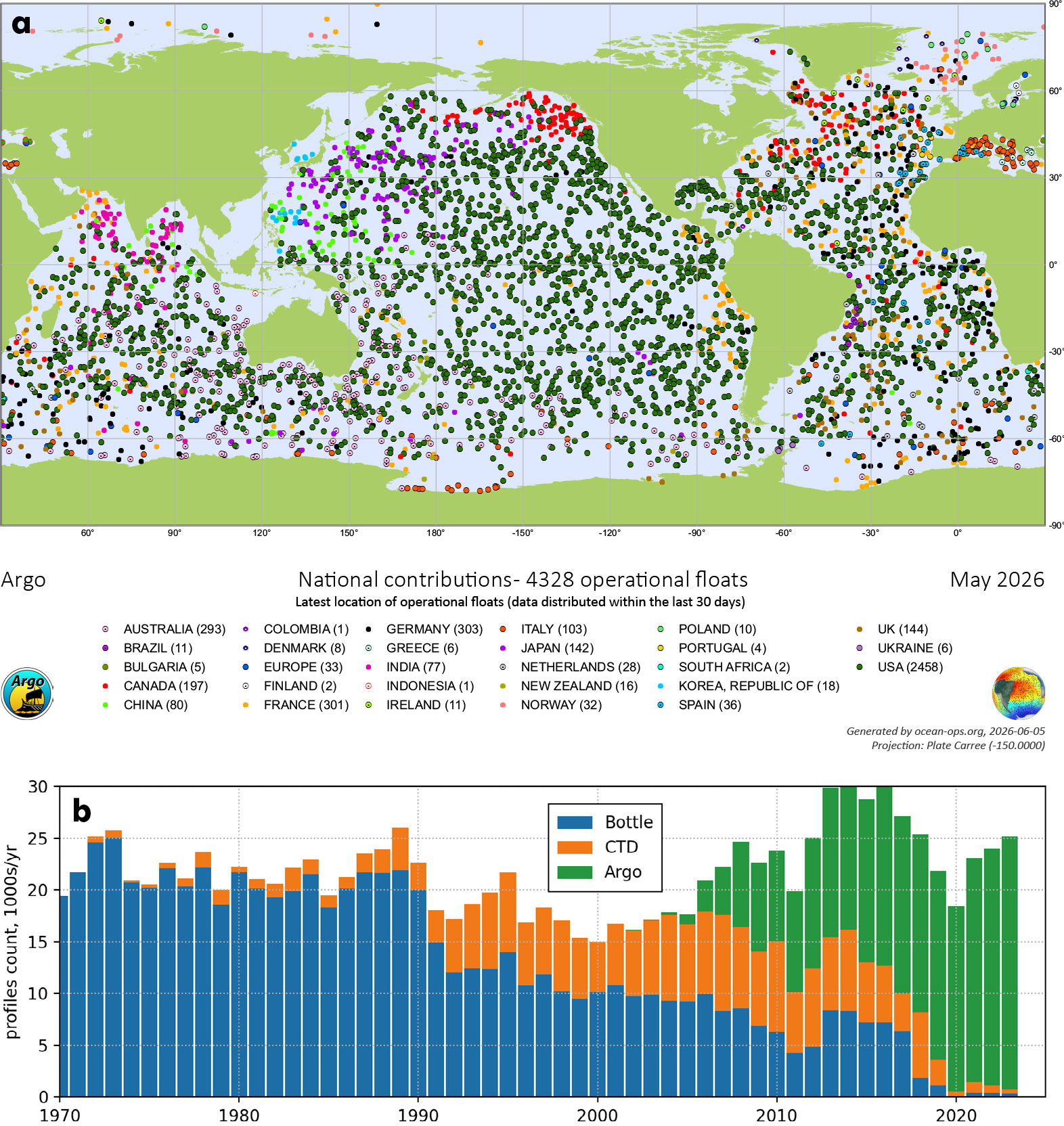
FIGURE 1. Status and contribution of the Argo network. (a) Dots represent operating floats contributed to the Argo network by various countries as of May 2026. (b) Oxygen profiles are plotted per year in the NOAA World Ocean Database collected by Argo as opposed to traditional observation methods (bottle, CTD). Panel (a) reproduced from ocean-ops.org. Panel (b) reproduced from Thierry et al. (2025), under CC BY license
> High res figure
|
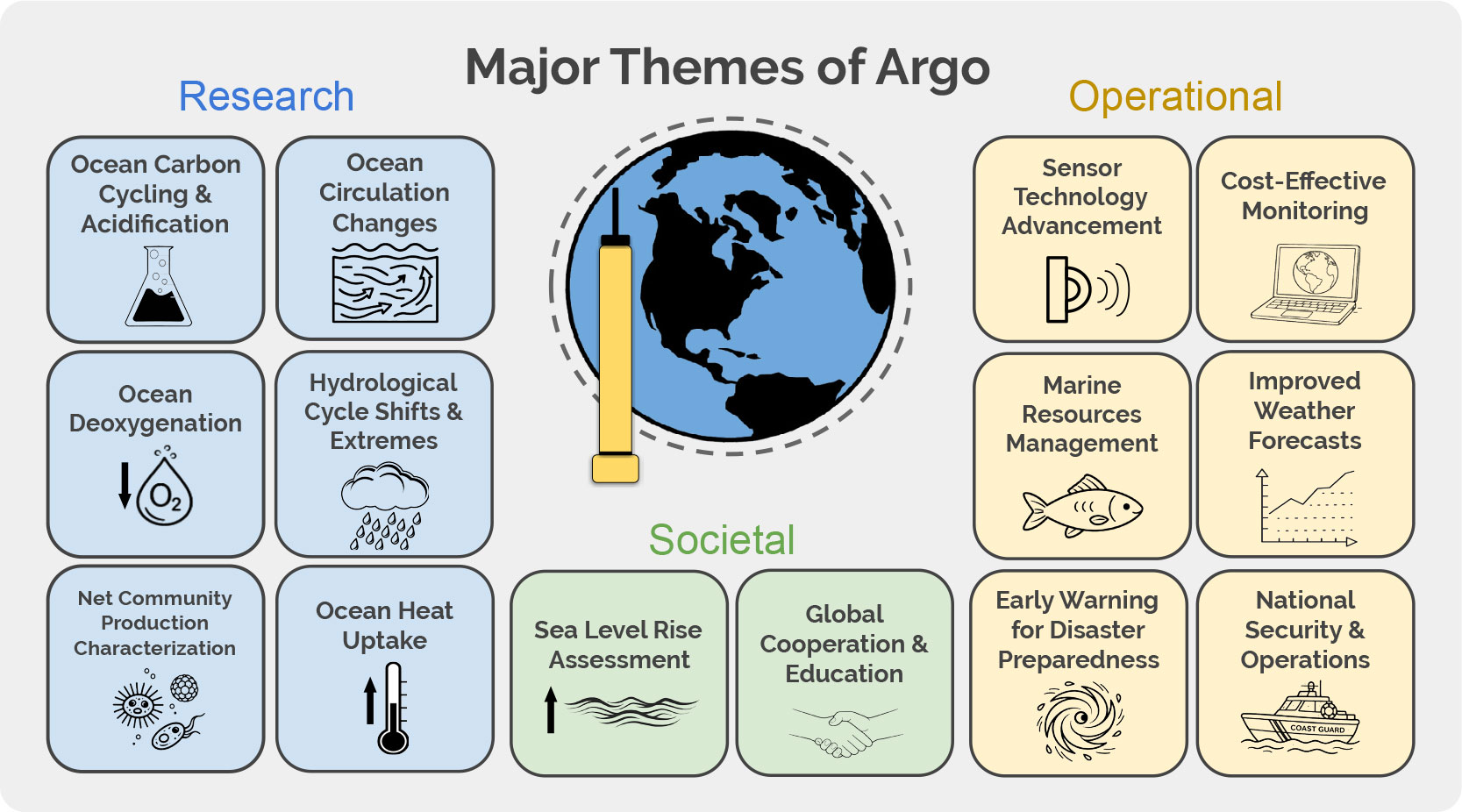
FIGURE 2. Operational, societal, and scientific goals and approaches enabled by Argo. Research themes include measurements of essential Earth system variables, both those directly observed and those calculated. Operational themes include capacity building and technological breakthrough potentials. Societal themes include international and national priorities for safety, security, and cooperation.
> High res figure
|
Argo has fundamentally reshaped understanding of the ocean’s role in the climate system by providing continuous, global measurements of temperature and salinity in the upper 2,000 m of the ocean. These observations underpin quantification of key climate indicators, including ocean heat content, sea level rise, and changes in the global hydrological cycle. More recently, through the Biogeochemical-Argo (BGC-Argo; Claustre et al., 2020) and Deep Argo (Zilberman et al., 2023) expansions, data coverage has been extended to include biogeochemical parameters and the full ocean depth. Together, the core observations of temperature and salinity, BGC-Argo, Deep Argo, and proposed polar expansions of Argo are referred to as “OneArgo” (Thierry et al., 2025). With its expanded capabilities, Argo has enabled advances in understanding full-depth ocean circulation and mixing, while also transforming observation of the ocean carbon system, biological productivity, and oxygen distribution (Claustre et al., 2020; G.C. Johnson et al., 2022). As highlighted in prior review articles, Argo now provides the dominant share of global subsurface observations for many essential climate variables (Figure 1), establishing an internally consistent benchmark for evaluating Earth system variability and change.
Beyond its scientific contributions, Argo provides a cornerstone for climatology, operational oceanography, and environmental prediction. Argo profiles are routinely assimilated into ocean and coupled Earth system models to constrain initial conditions, reduce uncertainty, and improve forecasts spanning short-range weather to seasonal and decadal climate variability (Figure 3). These observations enhance prediction of phenomena such as the El Niño-Southern Oscillation (ENSO), marine heatwaves, and tropical cyclone intensity, and are operationally integrated into forecasting systems at US agencies that include the National Hurricane Center of the National Oceanic and Atmospheric Administration (NOAA; Halliwell et al., 2017) and the US Navy (Chen et al., 2017), as well as those at international modeling centers (Balmaseda et al., 2024). Argo data are also central to ocean reanalyses, providing coherent reconstructions of the evolving ocean state and critical benchmarks for climate models; in many regions, Argo is the dominant source of subsurface ocean observations for these systems. Its global, internally consistent data record further supports emerging essential satellite measurement calibration and bias correction efforts, as well as artificial intelligence and machine learning (AI/ML) approaches that rely on large training datasets to improve prediction of ocean and climate variability (Forget, et al., 2015; Jiménez-Esteve et al., 2025). At the same time, the growing biogeochemical Argo record enables detection of declining ocean oxygen and hypoxic regions, with implications for marine ecosystems, fisheries management, and nitrogen cycling (Claustre et al., 2020; Thierry et al., 2025).
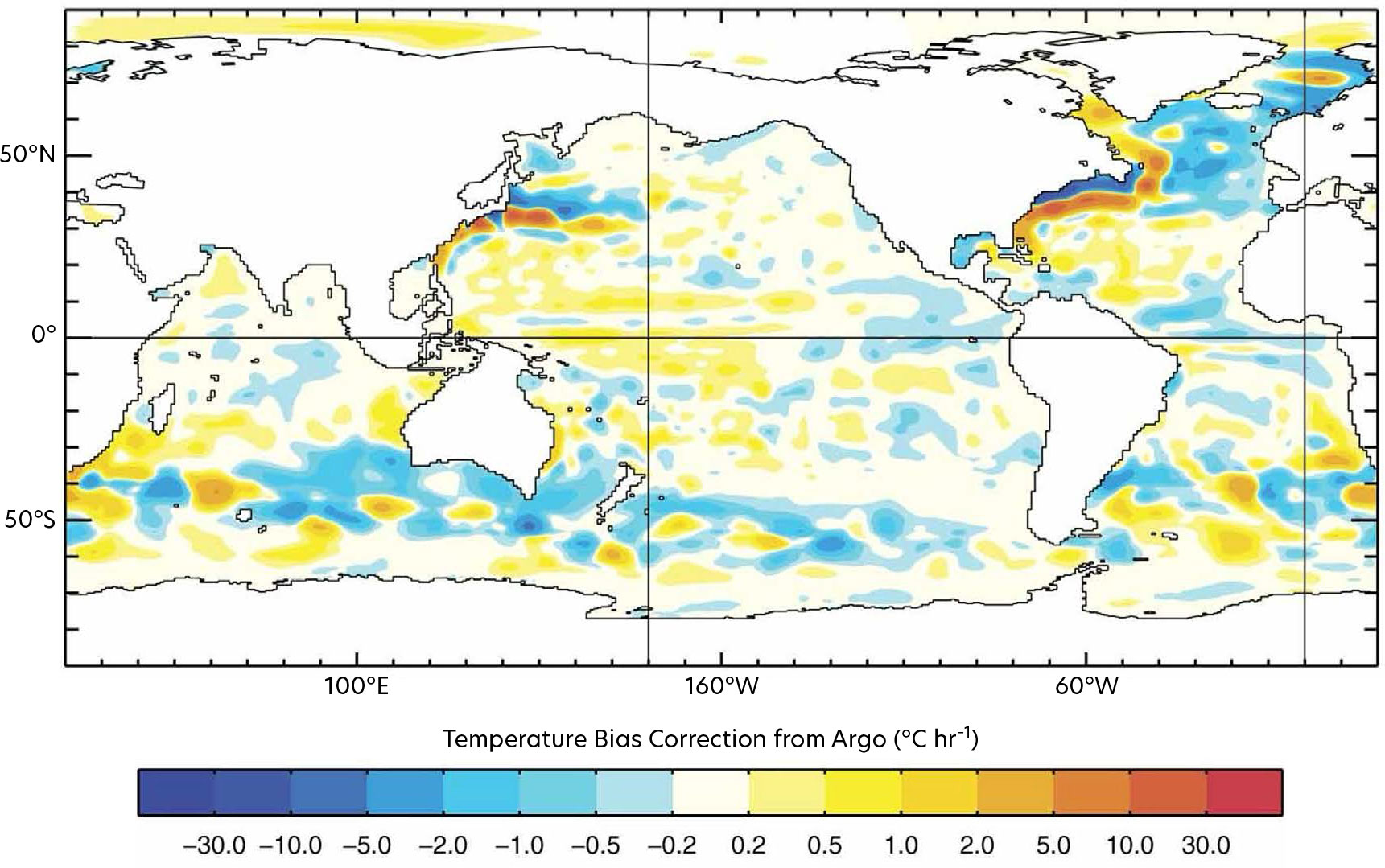
FIGURE 3. Temperature correction estimated from Argo float observations for depths of 300–700 m. This correction represents how model temperatures are adjusted over time to better match real-world ocean measurements, as applied within the ORAS4 ocean reanalysis (a combined model-observation ocean reconstruction). Figure reproduced from Balmaseda et al. (2013)
> High res figure
|
Finally, Argo’s openly accessible, near-real-time data have also had a profound impact on education and workforce development. The program has supported hundreds of graduate theses across oceanography, climate science, and related fields (Argo, 2024) while also serving as a widely used resource in undergraduate curricula. At the K–12 level, initiatives such as Adopt-a-Float and curated educational materials have enabled primary and secondary school students worldwide to engage directly with real ocean data, fostering early interest in Earth science, engineering, and data literacy. More broadly, Argo exemplifies the value of open, international scientific infrastructure, providing equitable access to high-quality environmental data and enabling participation from a global community of researchers, educators, and students.
Argo’s Return on Investment
Given its immense and wide-ranging impacts (Figure 2), Argo delivers unparalleled value for its cost. In the last 25 years, Argo floats have collected over three million temperature and salinity profiles, greatly exceeding the number of subsurface (>1,000 m) observations available from the historical record prior to Argo (Wong et al., 2020; Thierry et al., 2025). BGC-Argo has helped fill the gap in oxygen data created by declining shipboard measurements (Figure 1b). This prolific output is achieved at a fraction of the traditional cost: producing one core Argo profile costs less than $250 (in present-day US dollars) compared to over $10,000 for one ship-based temperature and salinity profile (Jayne et al., 2017). Likewise, a biogeochemical profile by BGC-Argo costs between $800 and $900, while collecting an equivalent suite of biogeochemical observations from a research vessel typically costs orders of magnitude more due to ship time and analytical expenses (K.S. Johnson and Claustre, 2026).
The value of these observations extends across sectors, supporting applications in weather forecasting, fisheries, shipping, and national security. While difficult to quantify precisely, Argo’s central role in GOOS implies economic benefits on the order of hundreds of millions of dollars annually (Kite-Powell, 2009). Crucially, no other observing system provides sustained, global subsurface coverage at comparable scale and cost. Satellite (Barale et al., 2010) and ship-based (Sloyan et al., 2019) observations are complementary but cannot replace this capability; a resilient ocean observing enterprise depends on the integration of all these observational data types.
Argo’s commitment to free and open data further amplifies its impact, ensuring that these observations are immediately accessible worldwide and fully utilized across scientific, operational, and societal applications (Roemmich et al., 1999). The freely available data guide actionable science such as detection of extreme weather and early warning signals for disaster response, maritime safety, and global shipping route optimization, as well as aquaculture and fisheries management. Open access to high-quality ocean observations also helps expand scientific capacity in developing countries, where freely available data are essential for advancing research programs, supporting education and workforce development, and enabling participation in the global ocean observing community.
The Necessity of Continuity to the Argo Mission
Sustained continuity is essential to Argo’s value. The program’s impact depends on not only global coverage but also the consistency of its long-term record. Interruptions in sampling or shifts in measurement systems risk degrading the climate data record in ways that cannot be recovered retrospectively (Lidström and Wickberg, 2025). Reduced coverage below scientifically determined targets for the Argo program—Core Argo (2,500 floats), Biogeochemical Argo (1,000 floats), and Deep Argo (1,200 floats)—will diminish the system’s ability to resolve seasonal-to-interannual variability, including early warning signals for extreme events. It will also weaken constraints on ocean heat and carbon uptake and increase uncertainty in estimates of large-scale circulation and water mass changes (G.C. Johnson et al., 2015; Chamberlain et al., 2023). Because the configuration of the Argo array is already minimal for meeting climate-scale objectives (Roemmich et al. 2009), further reduction would not only degrade resolution but also risk crossing thresholds beyond which key signals become aliased or undetectable (Sivareddy et al., 2017; Gasparin et al., 2023). Maintaining full coverage is not an aspirational goal but a requirement for preserving the integrity, usability, and long-term societal value of GOOS. Reduction of the Argo program would undermine basic as well as actionable research and their critical roles in protecting ecosystems and societies.
The continuity of Argo is critical because systems, such as forecasting and reanalysis, and emerging AI/ML applications, depend on Argo as their primary source of subsurface observations (Forget et al., 2015; Lellouche et al., 2021). Disruptions would propagate directly into reduced forecast skill and increased uncertainty. The implications of a reduced Argo program extend beyond science to economic stability and national security. Given the reliance on Argo data across a wide range of economic sectors, from shipping and fisheries to disaster preparedness and national defense, gaps in coverage represent a form of strategic vulnerability. Argo provides not only observations of the ocean but also the basis for decisions that affect billions of dollars in economic activity and public safety. Ensuring continuity is therefore essential to maintaining reliable environmental intelligence in a changing climate.
The continued development and deployment of new technologies, including improved sensors that can expand observational capabilities, increase accuracy, and reduce costs, are key aspects of the Argo system. However, given the importance of data continuity, advances in sensor technology must be integrated carefully. The strength of the Argo program lies in the stability and comparability of its long-term record, which depends on consistent measurement practices across decades (Roemmich et al., 1999; Riser et al., 2016; Thierry et al., 2025). Introducing new sensors inevitably risks introducing biases, calibration offsets, or shifts in data characteristics that can mask real climate signals. To avoid this, sensor evolution must be accompanied by careful cross calibration, overlap between old and new technologies, and rigorous validation against reference standards (World Meteorological Organization, 2015; Biogeochemical-Argo Planning Group, 2016). At the same time, failing to adopt improved sensors would limit the system’s ability to address emerging risk factors and scientific questions, from ocean carbon uptake to deoxygenation (Ito et al., 2026). The challenge, therefore, is not to choose between consistency and innovation, but to manage their coexistence and intensify effort, ensuring that technological progress strengthens the observing system without compromising sustainability or the integrity of the environmental record it is designed to sustain.
New Frameworks for an Indispensable Program
Meeting the research, operational, and educational demands of the coming decades may require rethinking Argo not simply as a research program, but as an enduring infrastructure. Currently, in the United States, which funds half of the international Argo program, it is funded through National Science Foundation (NSF), National Aeronautics and Space Administration (NASA), and NOAA research programs rather than through a dedicated long-term operational infrastructure line. As reliance on Argo data grows across forecasting, climate monitoring, and decision-making systems, its sustained operation must be treated with the same priority as other core environmental observing networks. This shift in framing from project-based funding toward long-term infrastructure investment would provide the stability needed to maintain continuity while enabling strategic and sustainable innovation (NASEM, 2017; European Marine Board, 2021).
Recognizing the need for a more scalable global observing network, the Argo community is advancing efforts to streamline technical infrastructure and operations. Argo-affiliated international partners, data system developers, and observing system engineers have already begun to develop new technical frameworks to improve efficiency and scalability. These efforts include modernizing data management pipelines, integrating cloud-based and AI-enabled workflows, improving interoperability across observing platforms, and developing more autonomous quality control systems to accommodate the rapidly growing volume and complexity of ocean observations. Efforts to standardize communication interfaces and data systems across float platforms are reducing operational complexity and lowering costs while also improving interoperability and data accessibility within the broader GOOS program. These advances position Argo to more seamlessly incorporate new technologies without fragmenting the observing network.
Emerging AI/ML approaches in data assimilation and ocean modeling are creating new pathways for scientific and operational advances, with Argo positioned as a primary source of the observations needed to train, constrain, and evaluate these next-generation systems. Throughout the program’s life, Argo observations have been routinely integrated into operational and research forecasting frameworks, underpinning ocean reanalyses and coupled climate predictions. Advances in AI/ML therefore build on an already mature assimilation infrastructure, offering pathways to improve how Argo data are used, potentially through more efficient data assimilation, model optimization, improved error characterization, and the capacity for adaptive sampling strategies that respond to evolving ocean conditions. Looking ahead, developments in high-performance computing systems and increased use of graphics processing units (GPUs) may further enhance weather prediction and ocean state estimation systems that already rely heavily on Argo. Rather than requiring a fundamental shift, these innovations position Argo to remain central to a new generation of forecasting systems that will support a more flexible and responsive observing network while preserving the continuity and reliability that make it indispensable.
Maintaining United States Leadership in a Global Success Story
Argo’s path has been one of remarkable success and collaboration, but the journey ahead demands critical decisions, renewed commitment, and potentially new organizational frameworks. In our view, augmenting Argo, not just maintaining it, is of the utmost importance for science and society. By extending observations to the full depth of the ocean, sustaining the newly built global BGC float array, and enhancing coverage in polar regions, the proposed expansion to a complete OneArgo by 2030 (Thierry et al., 2025) would transform our mechanistic and quantitative understanding of the world ocean as well as our ability to predict its future evolution. This evolution is not merely an enhancement of existing capabilities but a necessary leap to address emerging scientific questions and environmental risks while continuing to support existing data-assimilating and machine-learning infrastructure.
Recently in the United States, leaders of the ocean science and technology agencies on the National Science and Technology Council have reaffirmed the value that data from Argo floats bring to all agency missions (National Science and Technology Council Subcommittee on Ocean Science and Technology, 2024). This reaffirmation presents an opportunity for the United States to strengthen its commitment, for fellow leaders in the Argo community (the European Union, United Kingdom, Japan, Canada, India, Australia) to expand their investment in the program, and for emerging leaders to play a larger role in this global initiative.
As we look ahead, the future of Argo presents several possible paths. In an optimistic scenario, sustained and reliable funding would support a technologically advanced, publicly accessible network that delivers unparalleled insights into our ocean and its societal impacts. By contrast, maintaining the status quo with flat or even decreased funding risks stagnation and an erosion of scientific and operational capacities. Because Argo is already deeply embedded in operational forecasting and climate monitoring frameworks, such degradation would directly reduce predictive skill for weather, climate, and ocean hazards, thus increasing the risk to humanity, societies, and individuals. If the United States does not rise to the challenge, international partners will need to shoulder the responsibility of sustaining momentum and shaping the next era of global ocean observations.
At this critical juncture, Argo represents a story of great past achievements through strong US involvement and international collaboration as well as expected future accomplishments with renewed dedication and financial support. The path we choose will determine not only the future of global ocean measurements but also our ability to understand and respond to the challenges posed by a changing climate and environment.
Acknowledgments
Any opinions or views expressed or implied herein are those of the authors and do not necessarily reflect the views of NASA, NOAA, the Department of Commerce, or their individual employers. The authors thank Alyssa Johnson, Alyssa Cannistraci, and Mike Patterson of the US CLIVAR program office for their assistance in the preparation of this manuscript.


 PDF
PDF